What Is Risk-Reward Ratio in Crypto Trading?
Risk management separates traders who last from traders who blow up. And at the centre of risk management sits one deceptively simple concept: the risk-reward ratio in crypto trading. If you have ever entered a trade without a clear stop-loss or take-profit level, you have already experienced what it costs to ignore it.
What Risk-Reward Ratio Actually Means
The risk-reward ratio describes the relationship between how much you stand to lose on a trade and how much you stand to gain. It is expressed as a ratio: 1:2 means you are risking 1 unit to potentially gain 2 units.
In plain terms: for every dollar you put at risk, you expect to make two back.
Simple example: You buy Bitcoin at $80,000. You place your stop-loss at $78,000 (a $2,000 risk per coin). Your take-profit target is $84,000 (a $4,000 potential gain per coin). That is a 1:2 risk-reward ratio — you risk $2,000 to potentially make $4,000.
The ratio does not tell you whether a trade will win. What it tells you is whether a trade is worth taking at all. A trade with a 1:0.5 ratio puts you at a structural disadvantage from the moment you enter. Over dozens of trades, those structural disadvantages compound into consistent losses — regardless of how good your market read is.
How to Calculate Risk-Reward Ratio
The formula is straightforward:
Risk-Reward Ratio = (Take-Profit − Entry) ÷ (Entry − Stop-Loss)
For a long position (buying): Risk = Entry minus Stop-Loss. Reward = Take-Profit minus Entry.
Concrete crypto example: You identify a setup on ETH/USDT on the 4-hour chart. Entry: $3,200 · Stop-Loss: $3,050 · Take-Profit: $3,650.
Risk = $3,200 − $3,050 = $150 · Reward = $3,650 − $3,200 = $450 · RR = $450 ÷ $150 = 1:3
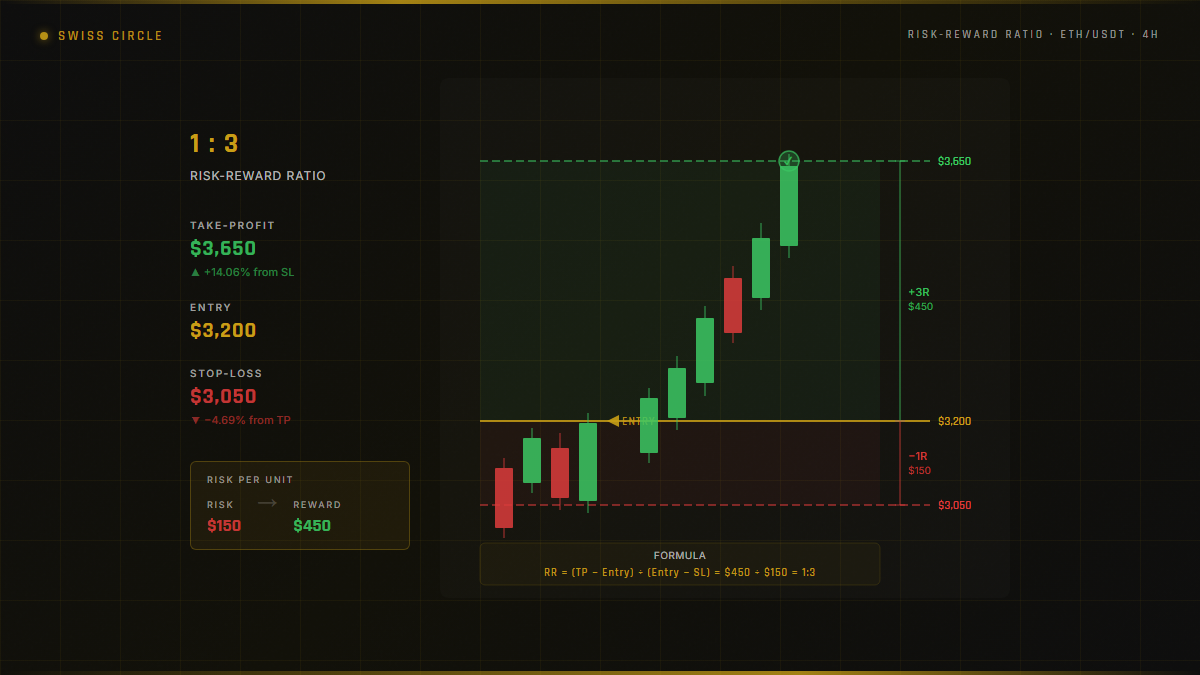
ETH/USDT · 4H · Entry $3,200 · SL $3,050 · TP $3,650 · Risk-Reward 1:3
For a short position (selling), you reverse the calculation: Risk = Stop-Loss minus Entry. Reward = Entry minus Take-Profit. The same logic applies — the direction changes, the principle does not.
At Swiss Circle, every trade signal includes a clearly defined Entry, Stop-Loss, and Take-Profit level. These are set before the trade is taken, because that is when disciplined risk management happens.
Why Most Retail Traders Ignore It (And Pay the Price)
Most retail traders operate on instinct. They enter a trade because the chart “looks good,” hold on when it moves against them, and take profit early when it moves in their favour. This is the exact opposite of how risk-reward works in practice.
Three patterns that destroy retail accounts:
- 1No stop-loss. Without a defined exit for when you are wrong, losses are theoretically unlimited. The position that was supposed to be a short-term trade becomes a long-term “investment” — because closing it would mean admitting the loss.
- 2Moving the stop-loss. Traders set a stop, watch the price approach it, and move it further away to avoid being stopped out. This turns a controlled loss into an uncontrolled one.
- 3Closing winners too early. A trader sets a take-profit at 1:3, but closes the trade at 1:1 because they are nervous. Now they need to win far more often just to break even.
The market does not care about your entry price. Defining your risk before you enter — and respecting those levels when the market tests them — is what separates structured trading from gambling.
The R-Multiple System
Professional traders do not think in dollar amounts when evaluating trades. They think in R-multiples.
R = the amount you risk on a single trade. If you risk $200 on a trade, that $200 is your 1R. Closing at your stop-loss = −1R. Closing at a 1:2 target = +2R. Closing at a 1:3 target = +3R.
By expressing every trade as a multiple of risk, you can evaluate performance across all positions regardless of position size or the coins traded. A +2R trade on a $100 risk and a +2R trade on a $500 risk represent the same quality outcome — just different scale.
At Swiss Circle, the team reports trade results in R-multiples precisely because it provides a clean, honest measure of trading performance. When every result is logged as an R-multiple, there is no hiding behind “but the market was difficult.” The numbers tell the story.
How Risk-Reward Connects to Win Rate
Here is the insight that surprises most beginners: you do not need to be right more than 50% of the time to be profitable. Your long-run profitability depends on the combination of your win rate and your average risk-reward ratio — not either one alone.
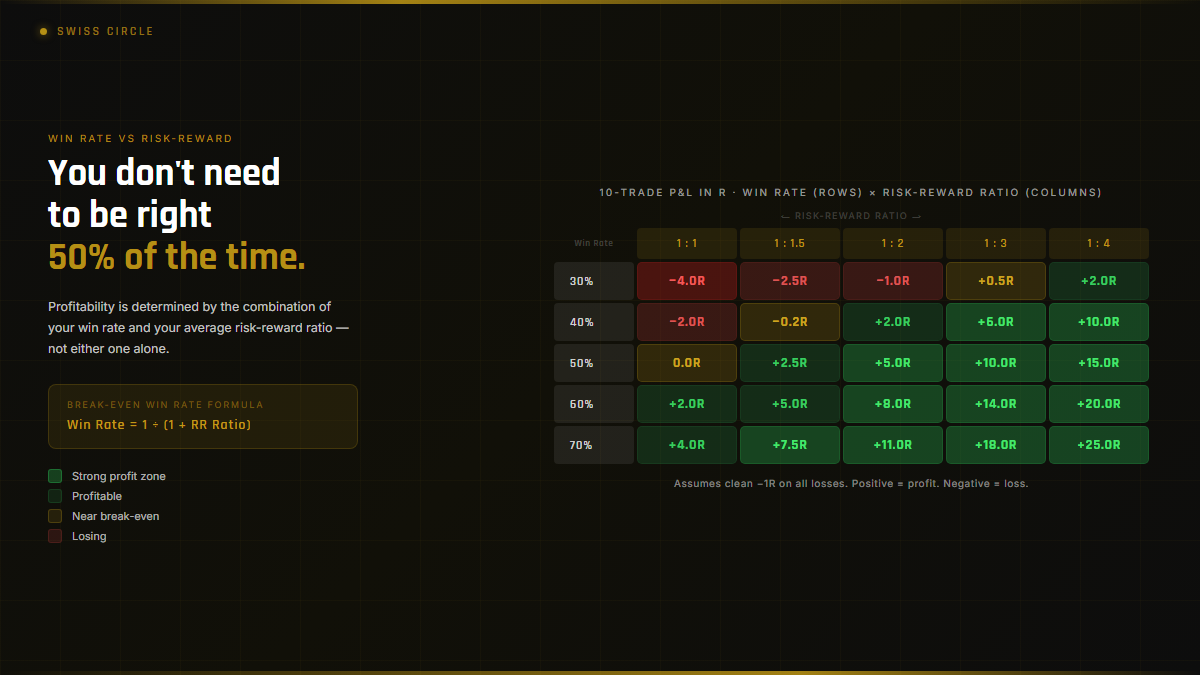
10-trade P&L in R across different win rates and risk-reward ratios. Green = profitable. Red = losing.
Consider two scenarios that illustrate why chasing a high win rate is often the wrong goal:
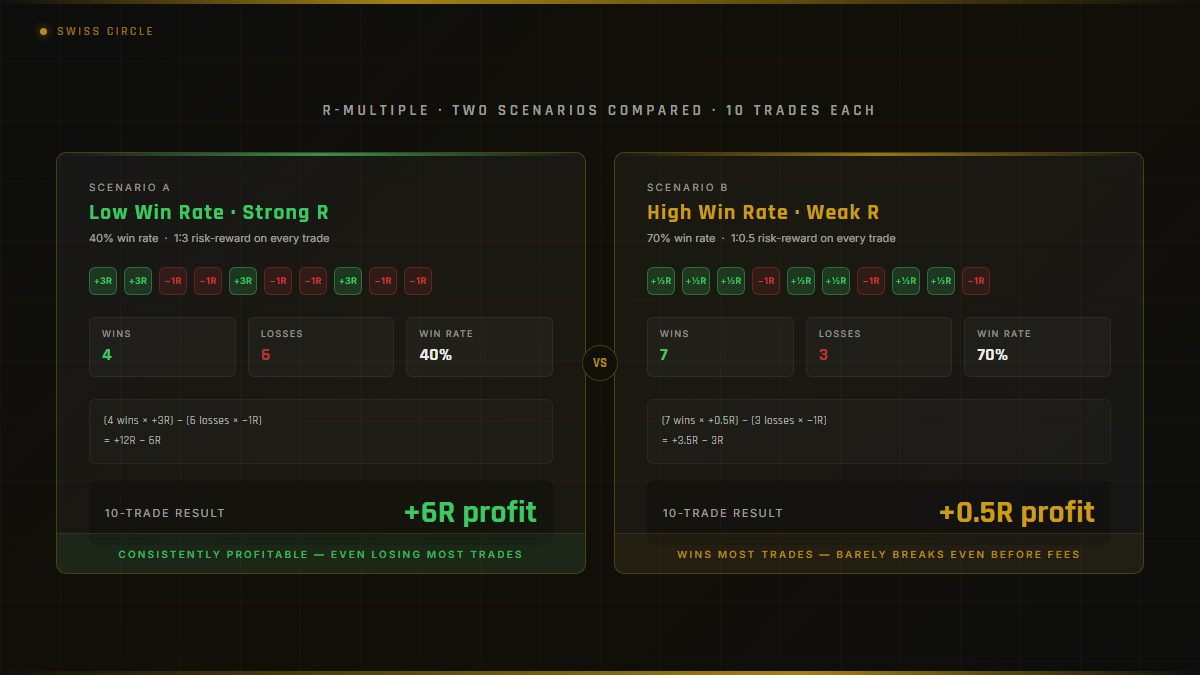
Scenario A wins 40% of trades and generates +6R. Scenario B wins 70% and barely breaks even.
The trader in Scenario A wins fewer trades but makes significantly more. The trader in Scenario B wins most of their trades and barely breaks even — before fees. This is why a trader who takes only high-quality setups with a minimum 1:2 risk-reward will, over time, outperform a trader who forces entries to maintain a feeling of being right.
The market rewards patience and structure, not ego.
Practical Tips for Applying Risk-Reward
- Set your stop-loss based on the chart, not your account balance. Your stop-loss should sit at a logical technical level — below a support zone, beneath a key moving average, beyond a recent swing low. Let the chart dictate the structure, then size your position accordingly.
- Aim for a minimum of 1:2 on every trade. At 1:2, you only need to win one in three trades to break even. At 1:3, one in four. The higher your minimum ratio threshold, the more margin for error you give yourself.
- Be realistic about take-profit levels. Setting a take-profit far beyond the nearest significant resistance inflates your theoretical risk-reward without reflecting market reality. Where has price stalled before? That is where your target belongs.
- Track every trade as an R-multiple. Keep a trading journal. Over 30 to 50 trades, patterns will emerge — you will see which setups genuinely pay off and which consistently underperform.
- Respect your stop-loss, every time. The stop is your pre-defined answer to: “At what point was I wrong about this trade?” If you move it, you are not managing risk — you are avoiding the feedback the market is giving you.
This article is for educational purposes only and does not constitute financial advice. Crypto trading carries significant risk. Always do your own research and manage your risk responsibly.