What Is Leverage in Crypto Trading — and When Should You Use It?
Leverage is one of the most powerful tools in crypto trading — and one of the most misunderstood. Used correctly, it lets you take meaningful positions with limited capital. Used carelessly, it can wipe out your account in a single move. This article covers exactly what leverage is, how it works mechanically, what liquidation means, and the honest answer to when you should and should not use it.
What Leverage Actually Is
At its core, leverage means borrowing capital from an exchange to open a position larger than your own funds would allow. You put up a portion of the total position value as collateral — called margin — and the exchange lends you the rest.
If you have $500 and use 10x leverage, you control a $5,000 position. Your $500 is the margin; the other $4,500 is effectively a loan from the exchange. Every percentage move in the asset’s price is now applied to the full $5,000, not just your $500.
That is why leverage is described as a multiplier. It amplifies the size of every outcome — in both directions.
Leverage = the ratio of your position size to your own capital. At 10x, a $500 margin controls a $5,000 position. Gains and losses are calculated on the full position, not on your margin alone.
How It Works Mechanically — A Clear Example
Let’s make this concrete. You have $500 and decide to open a long position on Bitcoin.
| Leverage | Position Size | +10% Move (Profit) | −10% Move (Loss) | Result on Capital |
|---|---|---|---|---|
| 1× | $500 | +$50 | −$50 | +10% / −10% |
| 5× | $2,500 | +$250 | −$250 | +50% / −50% |
| 10× | $5,000 | +$500 | −$500 | +100% / −100% |
At 1x leverage, a 10% move in Bitcoin earns you $50 on a $500 position — a 10% return. At 10x, the same 10% move earns $500 — a 100% return on your capital. But notice the other side: at 10x, a 10% move against you also returns −100%, meaning your full capital is gone. That is not a theoretical outcome. It happens, and it happens fast in crypto markets.
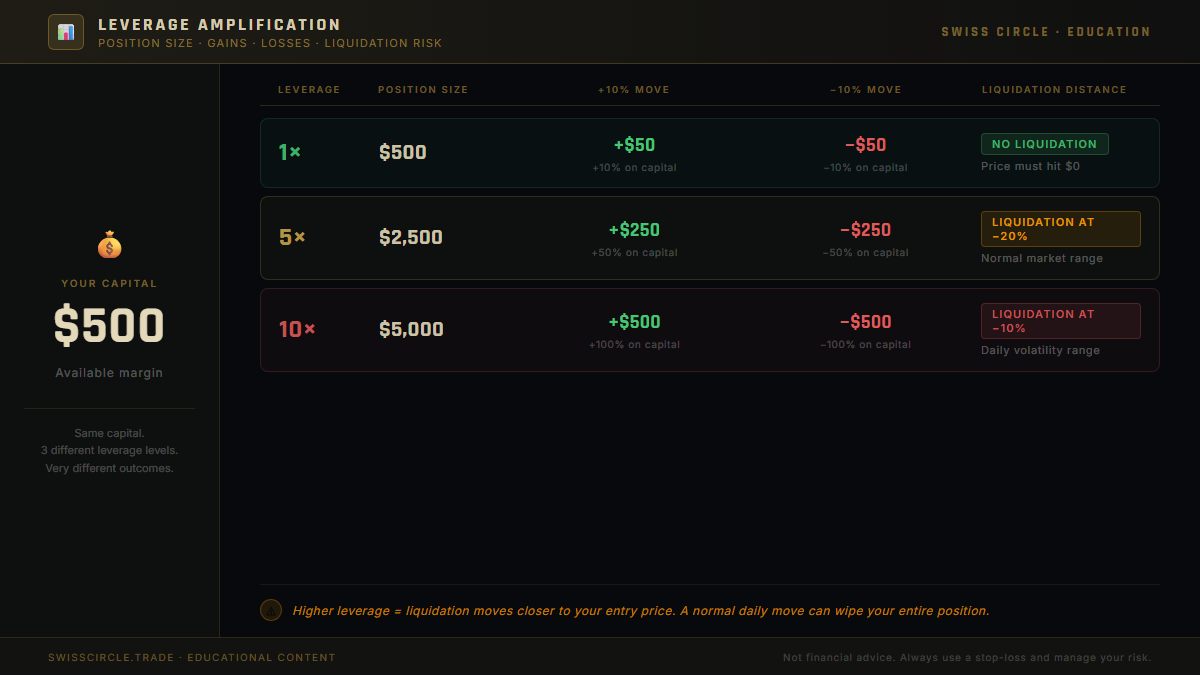
$500 capital · Same market move · Three very different outcomes depending on leverage level
Leverage Amplifies Both Gains and Losses Equally
This is the part people understand intellectually but often fail to internalise emotionally. Leverage does not discriminate. It does not amplify only your wins. Whatever multiple you apply, it applies to losses just as precisely as it applies to gains.
A 5x leveraged position that moves 20% against you is a full loss of your capital. At 10x, a 10% adverse move does the same. The mathematics are symmetrical. There is no mechanism that lets you keep the upside amplification while protecting against the downside amplification. What you use to make more, you also use to lose more.
This asymmetry of perception versus reality is why leverage destroys so many retail accounts. Traders focus on what they could win and underestimate how quickly the loss side arrives.
What Liquidation Is and How to Calculate It
When you trade with leverage, the exchange will close your position automatically if your losses approach the amount you put up as margin. This is called liquidation. The exchange does this to protect itself from you losing more than you deposited.
The point at which this happens is your liquidation price.
Liquidation Price ≈ Entry Price × (1 − 1 ÷ Leverage)
Example: Entry $50,000, 10x leverage → Liquidation ≈ $50,000 × (1 − 0.10) = $45,000
That is a 10% drop from your entry. Normal crypto volatility.
Here is why this matters in practice: Bitcoin routinely moves 5% to 15% in a single trading day. At 10x leverage, your liquidation sits just 10% below entry. At 20x, it sits just 5% away. On a volatile day, the market can reach your liquidation price in a matter of hours — or minutes — even if it eventually reverses and your original direction was correct. You are liquidated before the move has time to play out.
The lower the leverage, the further away the liquidation price sits from your entry, and the more time and space the trade has to develop.
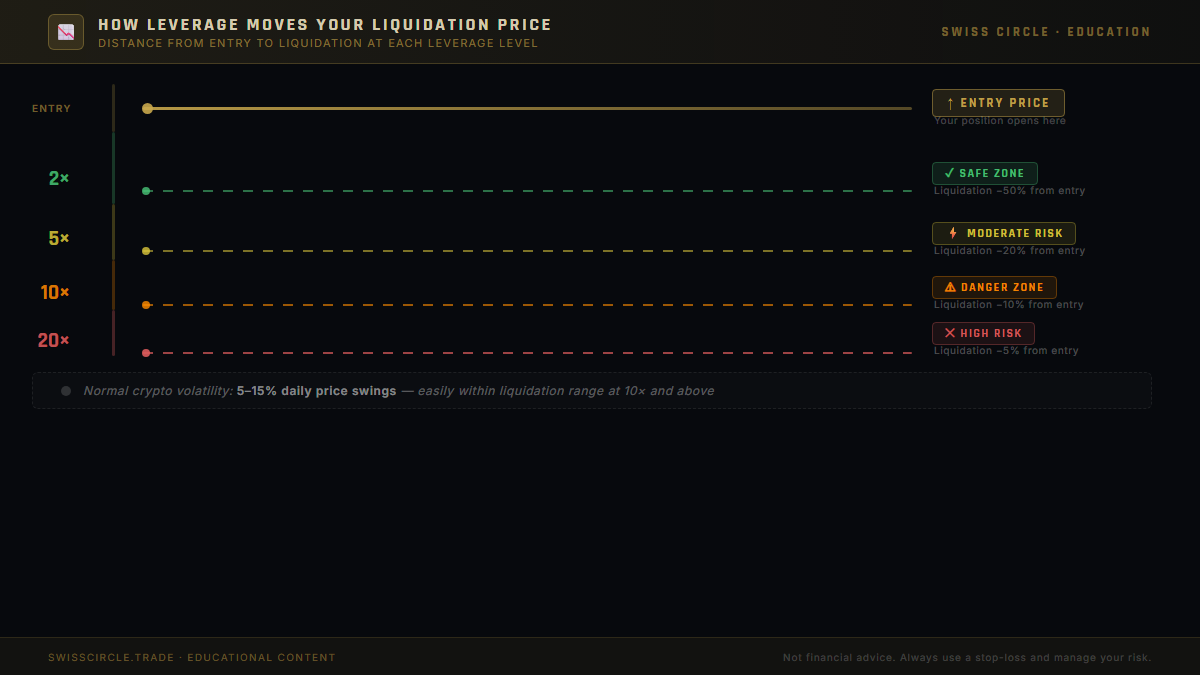
The higher the leverage, the closer the liquidation line sits to your entry · Normal daily crypto volatility is 5–15%
Comparing Leverage Levels: 2x vs 5x vs 10x vs 20x
Not all leverage is equally dangerous. The difference between 2x and 20x is not just a matter of degree — it is a qualitative difference in how much room the trade has to breathe.
- 2× 2x leverage: Liquidation sits 50% below your entry. This is comparable to how much a stock can fall and still recover. Position size is doubled, so gains and losses are doubled. This is the minimum leverage level and the appropriate starting point for anyone new to derivatives trading.
- 5× 5x leverage: Liquidation sits 20% below entry. A significant correction in a bear market or during a high-volatility event can reach this level. Gains are multiplied meaningfully, but so is the risk. A defined stop-loss placed before the liquidation price is not optional at this level — it is mandatory.
- 10× 10x leverage: Liquidation is just 10% from entry. Bitcoin has moved more than 10% in a single hour on multiple occasions. This leverage level demands precise entry timing, tight stop-loss placement, and constant awareness of market conditions. It is not suited to swing trading or holding through volatile periods.
- 20× 20x leverage: Liquidation sits 5% from entry. Any experienced trader will tell you this is scalping territory. The market can reach this level on a single candle during normal trading hours. Without institutional-grade entries and real-time risk management, this leverage level is closer to gambling than trading.
The pattern is clear: as leverage increases, the liquidation price moves progressively closer to your entry, leaving less and less room for the trade to develop. Higher leverage demands not just better risk management — it demands fundamentally better timing.
When Leverage Makes Sense
There are genuine, legitimate reasons to use leverage in crypto trading. The key is that they are context-specific, not universal.
- High-conviction setups with a clearly defined stop-loss. When you have a technically well-defined entry with a tight invalidation level — for example, buying a breakout where the structure breaks if price closes back below the range — a moderate leverage level lets you take a meaningful position with a risk amount that fits your account.
- Capital efficiency in range-bound conditions. If a coin is consolidating and you have high confidence in the range, leverage lets experienced traders extract more from a controlled move without deploying disproportionate capital.
- Short-term scalping with fast exits. Scalpers operate on timeframes of minutes to hours with very tight stop-losses. The short duration of the trade limits exposure to the kind of sustained adverse move that triggers liquidation on longer time horizons.
- Hedging an existing spot position. A leveraged short can be used to partially hedge downside risk on a spot holding during uncertain macro conditions, without selling the underlying asset.
The common thread in every legitimate use case is this: the risk is defined before the trade is opened. Entry is known. Stop-loss is set. The maximum loss is calculated. Leverage is then sized based on that structure — not the other way around.
When Leverage Is Dangerous
Leverage is dangerous in far more situations than it is useful. Here are the conditions that reliably lead to blown accounts.
Trading without a stop-loss. This is the single fastest way to get liquidated. Without a predefined exit, you are relying entirely on the market reversing before your margin runs out. Sometimes it does. Often it does not. And when it does not, you lose everything.
- 1 Beginners using high leverage. Without experience reading market structure, understanding volatility, and managing positions under pressure, leverage amplifies every mistake. A beginner who loses 10% on a spot trade loses 10%. The same beginner at 10x leverage loses their entire position.
- 2 Wide stop-loss combined with leverage. Setting a stop-loss at 15% below entry while using 10x leverage means your account is gone before your stop-loss even triggers. Leverage and stop-loss placement must be coordinated. If your stop distance is wide, your leverage must be low.
- 3 Trading on emotion. Entering a position because the market is moving and you feel like you are missing out, then adding leverage to “make back” a previous loss, is one of the most common account-destroying patterns in retail trading. Leverage requires a clear head and a pre-defined plan.
- 4 High-impact news events and low liquidity periods. During major economic announcements, Federal Reserve decisions, or during overnight and weekend low-liquidity windows, price can move violently and unpredictably. Leveraged positions are especially vulnerable to rapid wicks that hit liquidation levels before price recovers.
The Swiss Circle Team Recommendation
At Swiss Circle, the approach to leverage is straightforward: conservative by default, context-specific by exception.
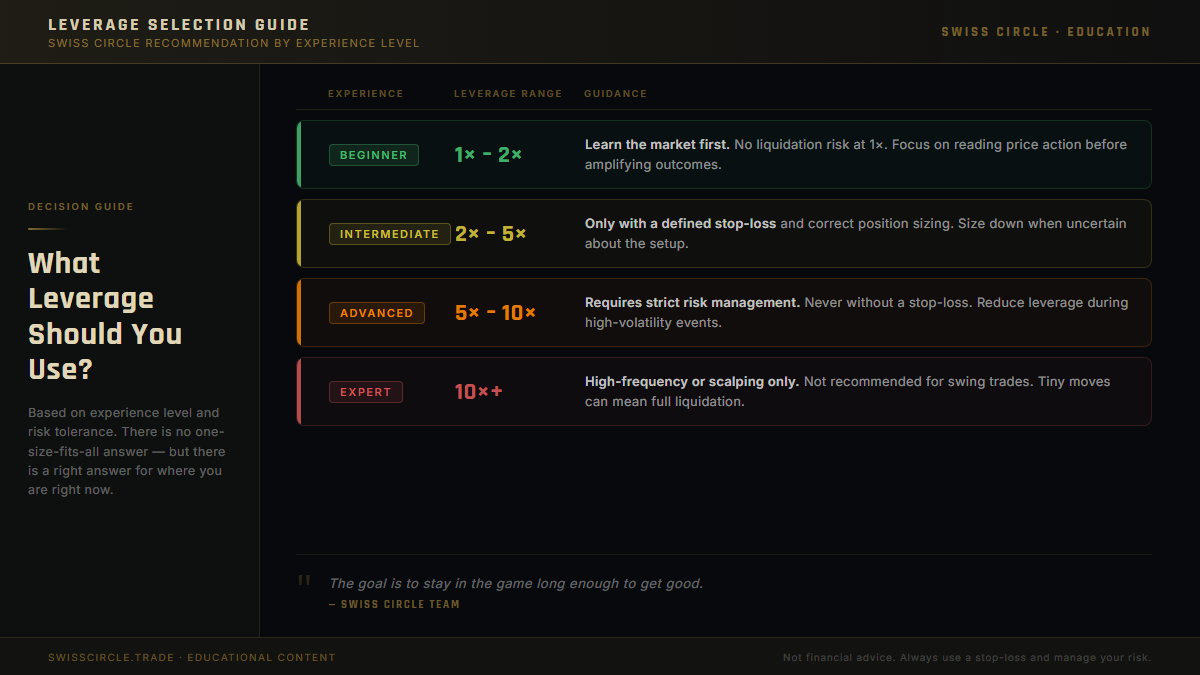
Swiss Circle recommended leverage ranges by experience level · Always use a stop-loss at every level
For beginners: Start at 1x or 2x maximum. Learn to read the market, build consistency, and understand how your emotions respond to positions moving against you before you add any leverage at all. A beginner who is consistently profitable at 1x can explore 2x. There is no rush.
For all levels: Always set a stop-loss before you enter a leveraged position. This is not a suggestion. It is the minimum requirement for trading with leverage responsibly. Your stop-loss defines your maximum loss. If you are not willing to accept that loss, do not take the trade.
Position sizing: Risk no more than 1–2% of your total trading capital on any single leveraged trade. Leverage determines your position size relative to your capital — it does not change how much of your account you should be willing to lose on one trade.
The goal when you are learning to trade is not to make the maximum possible return on any single trade. It is to stay solvent long enough to build the pattern recognition, emotional discipline, and risk management habits that make profitable trading possible over hundreds of trades. Leverage at inappropriate levels removes that possibility entirely.
No single trade, regardless of how strong the setup looks, is worth risking a significant portion of your capital. The traders who last in this market are the ones who are still here after the volatile periods — not the ones who pushed the hardest when conditions were good.
This article is for educational purposes only and does not constitute financial advice. Trading with leverage involves substantial risk and is not suitable for all investors. You can lose more than your initial margin. Always do your own research, use a stop-loss on every trade, and manage your risk responsibly. Never trade with capital you cannot afford to lose.