AI Agents vs Traditional Crypto Signals: What’s the Difference?
AI agents are everywhere in crypto right now — and most of the coverage is either breathless hype or reflexive scepticism. Neither is useful. This article cuts through it with an honest, side-by-side assessment of how AI trading agents actually work, where they genuinely add value, and where human analysts still hold the edge.
What Traditional Crypto Signals Actually Are
A traditional trading signal is the output of a human analyst’s decision-making process. The analyst reviews chart structure, macro backdrop, on-chain data, and market sentiment — weighs all of it against their experience — and publishes a trade idea with a defined Entry, Stop-Loss, and Take-Profit.
The critical word there is human judgment. Before a signal is posted, an actual person has decided that this setup, in this market condition, at this moment, is worth the risk. That decision carries accountability. If the trade fails, there is a named analyst whose reasoning can be examined, challenged, and learned from by the community.
Traditional signals are slower than algorithmic systems. They require the analyst to be available, to be paying attention, and to make an active call. But that slowness is inseparable from the deliberateness — you are not getting a pattern match, you are getting a considered opinion from someone with skin in the game.
What AI Trading Agents Actually Are
An AI trading agent is an autonomous software system that monitors market data — price action, order book depth, on-chain flows, social sentiment, news feeds — and either executes trades directly or surfaces alerts when predefined criteria are met, all without requiring human review of each individual decision.
The most capable systems combine multiple data streams and use machine learning models to identify patterns that precede price moves. Some are fully autonomous — connected directly to an exchange and authorised to open and close positions. Others operate in an advisory mode, flagging setups for a human to approve before execution.
The defining characteristic of an AI agent is speed and scale. Where a human analyst can meaningfully track perhaps a dozen markets at once, an AI agent can monitor thousands of pairs simultaneously, around the clock, without fatigue. It reacts in milliseconds. It does not feel fear when a position moves against it, and it does not feel greed when a position moves in its favour.
What it cannot do is understand why something is happening — only that a pattern it has seen before is present again.
Key Differences, Broken Down
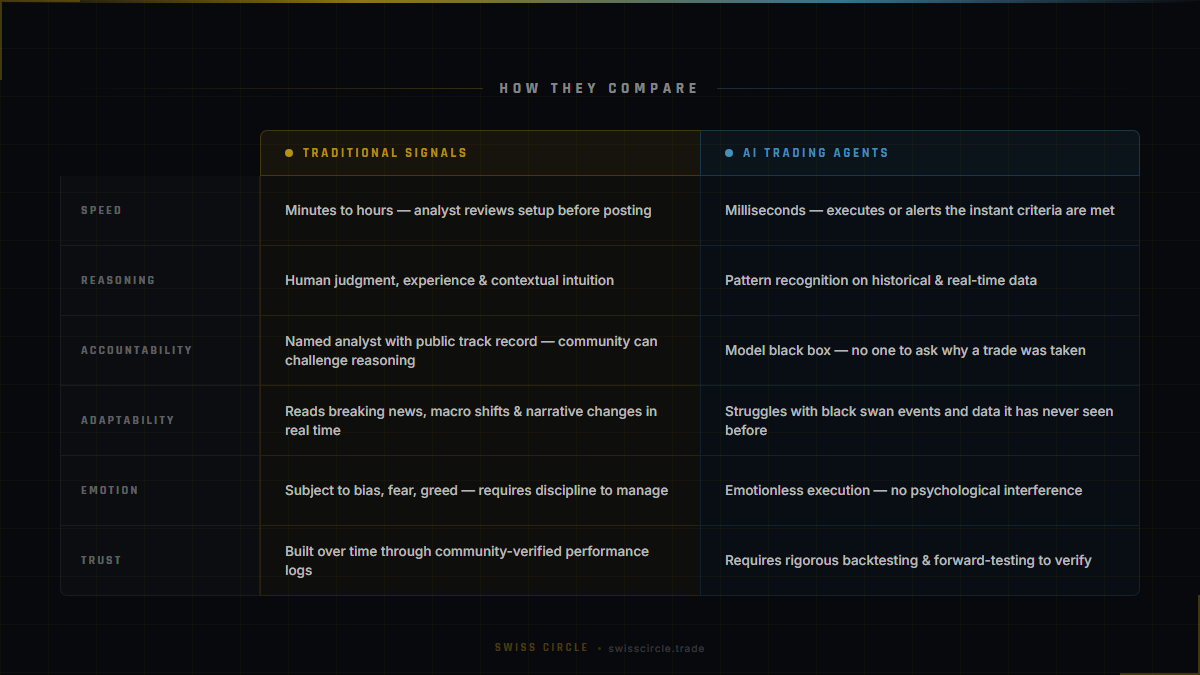
Six dimensions where traditional signals and AI agents diverge — no clear winner across the board.
The comparison above avoids declaring a winner because there genuinely is not one. Each approach has structural advantages and structural weaknesses. Understanding them is what allows a trader to use both intelligently.
- 1Speed. AI agents win on speed without contest. A human analyst publishing a signal within minutes of a setup forming is performing well. An AI agent can identify and flag the same setup within milliseconds. In highly liquid markets where price moves fast, this matters.
- 2Reasoning. Human analysts bring contextual judgment that no current AI system can replicate. They can read a tweet, absorb breaking news, interpret a regulatory announcement, and factor it into their analysis in real time. AI agents reason from historical patterns — which is powerful in stable market regimes, and brittle in novel ones.
- 3Accountability. When a human analyst publishes a signal, they attach their reputation to it. The community can ask why the trade was taken. The reasoning is documented. When an AI agent makes a call, the logic is often opaque — a black box output from a model that cannot be meaningfully interrogated.
- 4Adaptability. Black swan events — exchange collapses, regulatory crackdowns, geopolitical shocks — are by definition events an AI model has limited training data on. Human analysts can pivot instantly when the narrative changes. AI agents continue executing the playbook they were built on until someone intervenes.
- 5Emotion. This cuts both ways. AI agents are immune to fear and greed — they will not close a position early because they are nervous, and they will not size up recklessly because they are overconfident. Human analysts face these pressures constantly. But human intuition — the product of pattern recognition built over years — is also a form of “emotion” that can be correct when models are wrong.
- 6Trust. Trust in a human analyst is built through a verified public track record over time. Trust in an AI agent requires rigorous backtesting and, more importantly, forward-testing in live conditions — which takes time and a transparent audit trail most retail-facing AI signal products do not provide.
Where AI Agents Genuinely Add Value
Being honest about this matters. AI agents are not a gimmick — in the right applications, they are genuinely superior to human-only processes.
- Scanning breadth. No human team can meaningfully monitor thousands of trading pairs simultaneously. AI agents can, and they will catch setups that human analysts miss simply because there are too many markets to watch.
- Emotionless execution on technical setups. When a setup is purely technical — a breakout of a defined level, a moving average crossover, a volume spike — removing the human from the execution loop can improve consistency. The human set the criteria; the machine applies them without hesitation.
- 24/7 coverage without fatigue. Markets do not close. Human analysts sleep. An AI agent monitoring for a 3am breakout will catch it; a human analyst will not, unless they are willing to set an alarm every night.
- Backtesting at scale. AI systems can be tested against years of historical data across hundreds of instruments in minutes. A human analyst building a trading strategy from scratch cannot do this at the same scale or speed.
- Removing emotion from entry timing. Even when a human analyst has identified a valid setup, they may hesitate at the entry point because of recent losses or recent wins. An AI agent executes the plan as written, every time.
Where Human Signals Still Win
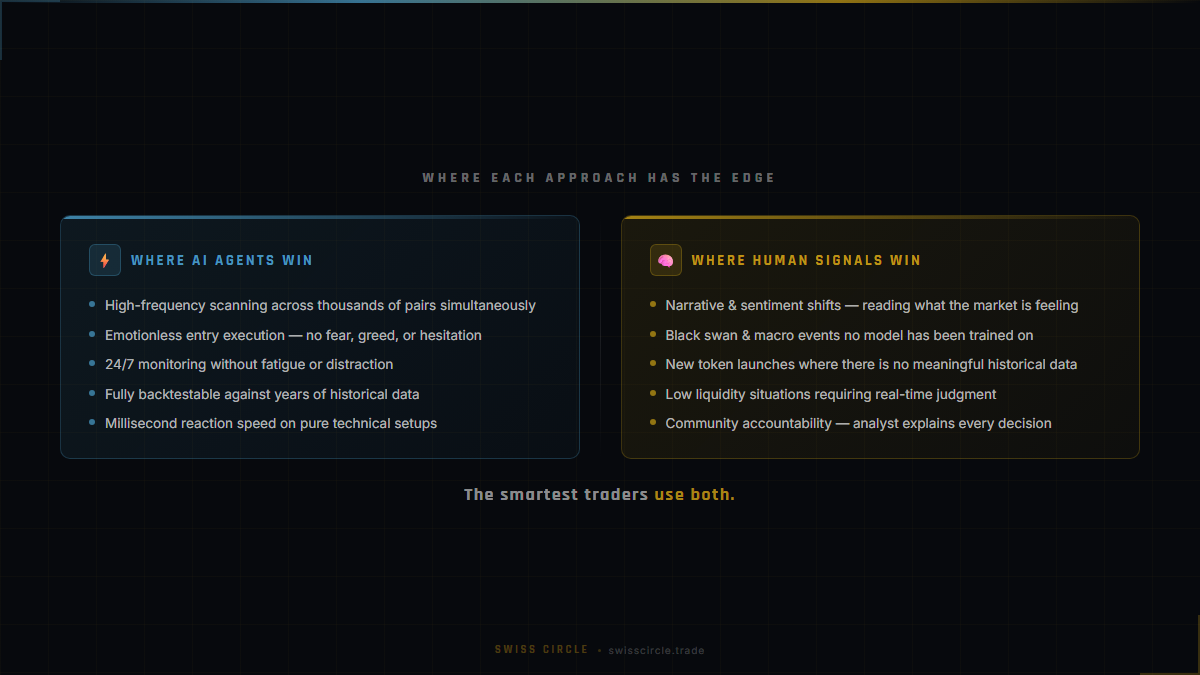
Neither approach dominates. The edge depends entirely on the market condition.
The situations where human judgment consistently outperforms algorithmic systems are worth understanding in detail — because these are precisely the situations that tend to cause the most significant losses in crypto markets.
AI models are trained on history. Markets are made by the future. When the future looks like the past, AI agents perform well. When it does not, human judgment is the only meaningful defence.
Narrative and sentiment shifts are the defining feature of crypto markets. A project is “dead” until it is not. A sector is saturated until institutional capital rotates in. These shifts happen through social discourse, not price action — and they often precede the price move by hours or days. Experienced analysts read this. Models typically lag it.
Black swan events — an exchange collapse, a major protocol exploit, a sudden regulatory action — are definitionally outside the historical distribution an AI agent was trained on. A human analyst who sees the news can respond within seconds: close positions, reverse exposure, post a community update. An AI agent continues executing its playbook until someone manually intervenes.
New token launches present a fundamental problem for data-driven models: there is no historical data to train on. Human analysts can evaluate tokenomics, team credentials, community strength, and narrative positioning from first principles. A model cannot.
Low liquidity situations are poorly handled by algorithmic systems. An AI agent optimised on deep-market data will fire signals in thin markets that a human analyst would recognise immediately as untradeable at that size.
The Hybrid Approach: How It Works in Practice
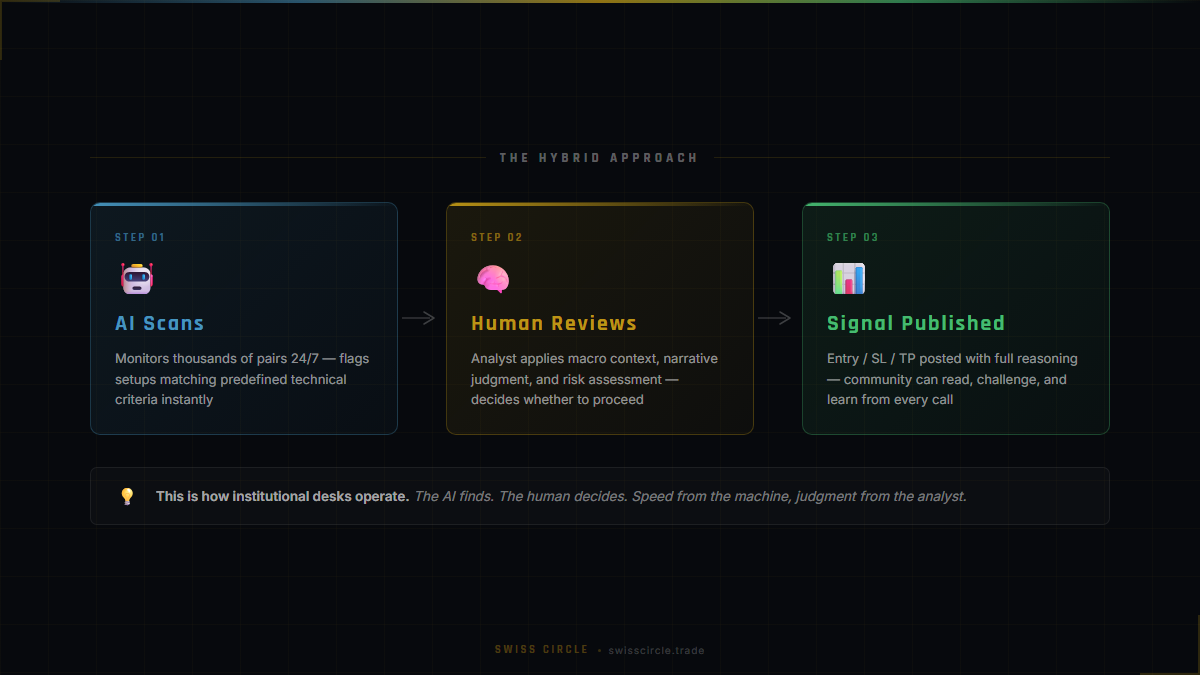
AI handles scale and speed. The analyst handles judgment and accountability. Neither replaces the other.
The most effective approach is not to choose between AI and human analysts — it is to use each where it is strongest. This is already how institutional trading desks operate, and it is increasingly how sophisticated retail traders work.
In a hybrid workflow, AI tools handle the scanning layer: they monitor thousands of instruments, flag setups that meet predefined technical criteria, and surface them to the analyst. The analyst then applies macro context, narrative awareness, risk judgment, and experience — and makes the final call on whether to publish a signal.
The result is speed without sacrificing judgment, and breadth without sacrificing accountability. The AI is not replacing the analyst; it is making the analyst more efficient. The analyst is not ignoring data; they are contextualising it.
This is not a theoretical construct. It is a practical workflow that removes the weaknesses of both pure approaches: the speed ceiling of human-only systems and the contextual blindness of AI-only systems.
Swiss Circle’s Approach
At Swiss Circle, signals are published by human analysts with transparent reasoning and full accountability to the community. Every signal includes a defined Entry, Stop-Loss, and Take-Profit. Every trade is logged. The reasoning is always visible — members can ask why a trade was taken, challenge the logic, and learn from both the winners and the losses.
We use data tools and market scanning technology to support our analysis. But the decision to publish a signal — and the accountability for that decision — sits with a named analyst every time. That is a deliberate choice, not a limitation.
The community element matters here too. When a signal is published with reasoning attached, other members can validate the logic, spot what was missed, and build their own analytical frameworks around it. That learning loop does not exist when a black-box algorithm fires a trade with no explanation.
We are not dismissive of AI tools — the hybrid approach described above reflects where the industry is genuinely moving. But we believe human judgment, transparency, and community accountability are features worth preserving at the centre of any serious signal service.
This article is for educational purposes only and does not constitute financial advice. Crypto trading carries significant risk of loss. References to AI trading systems and signal services are for educational comparison only. Always conduct your own research and consult a qualified financial adviser before making investment decisions. Manage your risk responsibly.